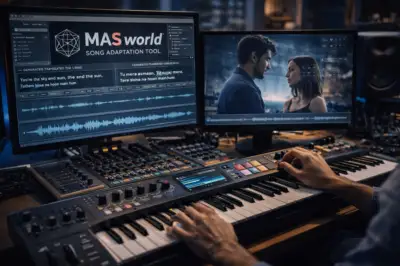

How MAS World Is Solving Song Adaptation in Movie and Series Dubbing
When films and web series are adapted into different languages, most of the focus is placed on dialogue. But for many productions, especially in India and global cinema, songs play an equally important role in storytelling.
Despite advances in dubbing, songs are still one of the least adapted elements in multilingual releases.
The reason is simple. Unlike dialogue, song lyrics are closely tied to rhythm, emotion, and musical structure. A direct translation often breaks the flow, making the dubbed version feel unnatural or disconnected from the original composition.
When films and web series are adapted into different languages, most of the focus is placed on dialogue. But for many productions, especially in India and global cinema, songs play an equally important role in storytelling.
Despite advances in dubbing, songs are still one of the least adapted elements in multilingual releases.
The reason is simple. Unlike dialogue, song lyrics are closely tied to rhythm, emotion, and musical structure. A direct translation often breaks the flow, making the dubbed version feel unnatural or disconnected from the original composition.
Because of this, many dubbed versions of films and series choose to retain original songs, even when the rest of the content is localized. While this maintains musical quality, it creates a gap in the viewing experience for audiences who do not understand the original language.
For content creators and studios, this has been a long-standing limitation.
Adapting songs requires more than translation. Lyrics need to be rewritten in a way that fits the melody, preserves meaning, and aligns with the emotional tone of the scene. This process has traditionally required significant creative effort, making it both time-consuming and expensive.
As a result, full song adaptation has often been reserved for high-budget productions.
However, this approach is beginning to evolve.
Newer workflows are exploring ways to support song adaptation using AI-assisted systems combined with human input. AI can help generate base lyric structures and align them with timing, while human teams refine the output to ensure it fits both musically and contextually. This highlights the growing need for song dubbing and lyric adaptation in multilingual content production, especially for films and web series with strong musical narratives.
This makes it more practical to consider song adaptation as part of the overall dubbing process, rather than treating it as a separate challenge.
In films and web series where music plays a central role, this shift can significantly improve how content is experienced across languages. Instead of switching between dubbed dialogue and original songs, viewers can engage with a more consistent and immersive version.
MAS World, an India-based AI-driven technology company, is among those working in this direction. The company focuses on multilingual dubbing for films, series, and music-based content, combining AI systems with team-based refinement. Its broader work in AI, including robotics and autonomous systems, reflects a wider approach to building scalable, real-world applications of artificial intelligence.
Sachin Gupta, CEO of MAS World, notes that song adaptation has traditionally been one of the hardest parts of dubbing. “Songs can’t be directly translated. They need to match rhythm, emotion, and meaning at the same time. That’s why we focus on adapting lyrics, not just translating them,” he explained.
As multilingual content continues to expand, the ability to adapt not just dialogue but also songs may become an important factor in how effectively content travels across regions.
For both creators and audiences, this represents a step closer to experiencing content in a way that feels complete, rather than partially translated.